
Buyer Guides
September 8, 2026
What Does $2 Million Buy in Manhattan?
Two million dollars sounds like plenty of money until you start touring apartments with it. In Tribeca or the West Village it barely covers a one-bedroom with obstructed light. Three neighborhoods over, in the East Village or Hell's Kitchen, the same budget can land a real two-bedroom with room to spread out. The neighborhood you pick matters as much as the number you bring to the table.
The math changes block by block, not just borough by borough.
What $2 Million Buys, Block by Block
Price per square foot is the clearest way to compare neighborhoods, since it strips out the differences in unit size. In the Lower East Side, where the average runs about $2,233 per square foot, $2 million works out to roughly 900 square feet, generally a real one-bedroom or a tight two-bedroom in a walk-up. The East Village runs a bit lower at around $2,051 per square foot, which stretches that same $2 million to about 975 square feet.
Head north into Hell's Kitchen or down to the Financial District and the math opens up. Both neighborhoods average under $1,600 per square foot, so $2 million buys somewhere between 1,250 and 1,360 square feet, often enough for a genuine two-bedroom with a home office nook. Financial District towers also tend to come with amenities that older Lower East Side walk-ups don't have, doormen, gyms, and package rooms among them.
Midtown East, Union Square, and Sutton Place land in between those two tiers. All three average between $2,100 and $2,200 per square foot, so $2 million works out to roughly 910 to 950 square feet, similar to the Lower East Side but often in a full-service building with a doorman and a live-in super. Midtown East adds a short walk to Grand Central on top of that.

Flatiron, NoMad, the Upper East Side, and the Upper West Side sit on the other end of the scale. Average sold prices in Flatiron and NoMad already run above $2 million, so that budget buys a smaller unit than the neighborhood average, often a one-bedroom loft conversion rather than the two-bedroom you would get on the Lower East Side. The Upper East Side and Upper West Side tell a similar story. Two million dollars sits below both neighborhoods' average sold price, which usually means an older prewar layout that needs updating, or a smaller footprint on a high floor.
Co-op or Condo at This Price
At $2 million, you are squarely in co-op territory in most of these neighborhoods, and that changes the process as much as the price. Board approval typically takes four to six weeks and asks for two to four times the purchase price in liquid assets on top of your down payment, a bar that trips up more buyers than the mortgage itself. My guide to condos versus co-ops walks through the tradeoffs in more detail.
Condos at this price point exist too, particularly in Hell's Kitchen, the Financial District, and newer Flatiron and NoMad developments. They trade the co-op discount for a higher per-square-foot price and, often, higher monthly charges.
Closing Costs on a $2 Million Contract
A $2 million purchase sits right at the edge of New York's mansion tax brackets. The mansion tax charges 1% on purchases between $1 million and $2 million, and the rate steps up to roughly 1.25% once you cross into the $2 million to $3 million bracket, according to the NYC Department of Finance. On paper that is the difference between a $20,000 tax bill and a $25,000 one, so where your final negotiated price lands relative to that $2 million line is worth watching during the offer stage.
Add attorney fees, title insurance, and a mortgage recording tax of about 1.8% on any financed portion, and total closing costs on a financed condo purchase generally run 4% to 5% of the price. Co-op buyers pay less, since co-ops are exempt from several of the transfer-related taxes condos carry. My closing costs guide breaks down every line item.
None of it shows up on the listing page, so budget for it before you write an offer.
Financing at This Price Point
Most $2 million purchases require a jumbo mortgage, since the loan amount clears the conforming limit the Federal Housing Finance Agency sets each year. Expect lenders to ask for at least 20% down, often more for a co-op board's comfort, plus a year or two of post-closing liquidity on top of the down payment. Rate movement matters more at this size than it does on a smaller loan. A quarter-point shift on a $1.6 million mortgage changes the monthly payment by several hundred dollars, and Freddie Mac's weekly survey is worth checking before you lock a rate. My mortgage guide for luxury NYC purchases covers reserve requirements and documentation in more depth.
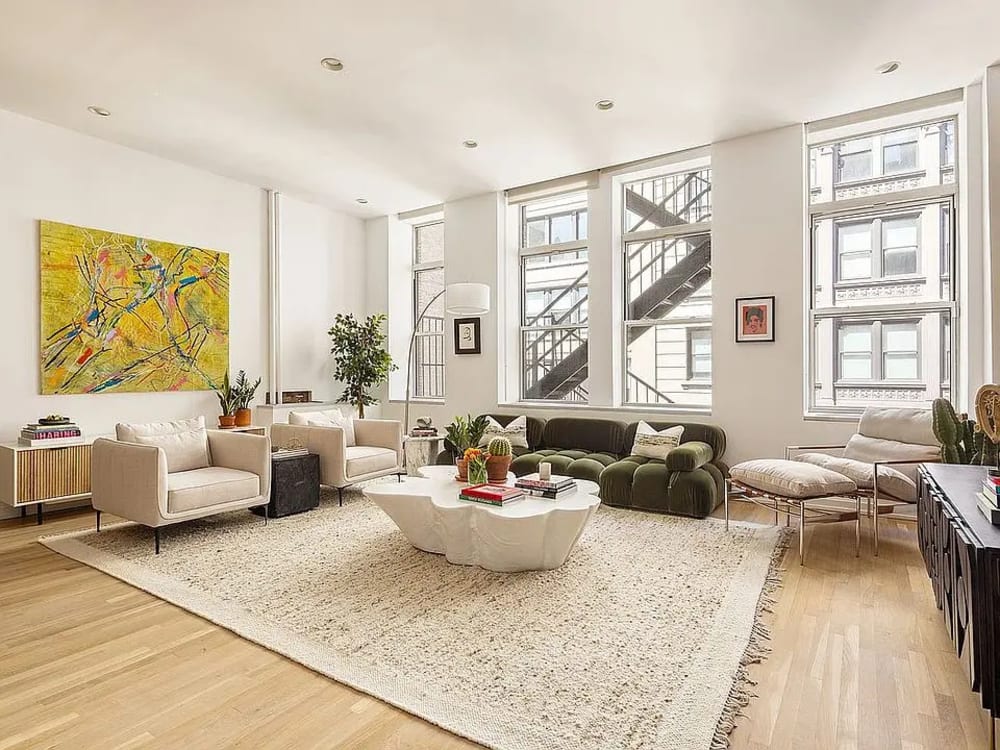
Where $2 Million Goes Further
Cross the river and the number changes shape entirely. Brooklyn averages about $1,423 per square foot borough-wide, well under most of Manhattan, and $2 million there can mean a full brownstone floor-through or a three-bedroom in a newer building rather than a Manhattan one-bedroom. Park Slope and Williamsburg both sit meaningfully below Manhattan's downtown average, which is a big part of why buyers who start their search in NoMad or Flatiron often end up touring Brooklyn before they sign anything. My comparison of Manhattan and Brooklyn living goes deeper into the tradeoffs.
These are neighborhood averages, not guarantees for any single listing. A specific unit's floor, light, renovation quality, and building all move the price up or down from the averages StreetEasy's market data tracks for the area, sometimes by a lot. Treat these figures as a starting map for where to look, not a promise of what one listing will cost.
Matching the Number to What You Want
What $2 million buys in Manhattan depends entirely on what you are willing to trade. Square footage, neighborhood prestige, building amenities, and renovation condition all compete for the same budget, and getting more of one usually means giving up another.
If you want to see what that budget looks like on the ground, in the neighborhoods you are considering and the ones you have not thought of yet, reach out directly at cbain@bhsusa.com or 212.814.9404. I can pull current listings in your range and show you the real tradeoffs before you spend a weekend touring apartments that do not fit what you need.
Back to BlogBuyer Guides
Related Articles

June 30, 2026 | Curtis Bain
NYC Rent Freeze 2026: What It Means for Buyers, Sellers & the Manhattan Market
VIEW ARTICLE
March 20, 2026 | Curtis Bain
NYC Closing Costs Explained: What Every Buyer Should Know
VIEW ARTICLE
February 18, 2026 | Curtis Bain